
Did the Watchtower Really Claim to be a Prophet?
I remember it well. I was sitting in the ornate kingdom hall in Ridgefield, New Jersey, in 1977. Plush movie-theatre-style seats, ornate black wrought-iron chandeliers, and a stone-floor foyer that inspired whispering. During one talk from the platform, we were told that Jehovah’s Witnesses were the modern-day Ezekiel class. Later, as we studied the Watchtower, we heard references to the Jeremiah class. Years afterward, I also heard the organization identify itself as the John class. I was a newly baptized Jehovah’s Witness, fully indoctrinated, and didn’t think much of it. The Governing Body heard from God and told us what they learned. We were a class of people, a prophet sounding out the warning to a dying world. Or so I thought.
I imagined the Governing Body as old wise men who sat around praying and hearing from God. Little did I know! In those days, we didn’t know who was on the Governing Body. They did not make public appearances, and few Witnesses could have named all of its members. Of course, in those days there were presidents. A solitary man in charge, first Nathan Knorr, then, after he died, Fred Franz. There was also a Governing Body, but the president held the ultimate authority. As rank-and-file Witnesses, we simply accepted that Jehovah was directing the organization and trusted what we were taught.
Something Jehovah’s Witnesses understand, but many Christians do not, is that the Watchtower often uses different terms for what is essentially the same role.
Over the years, the organization has identified itself as the Jeremiah class, Ezekiel class, John class, Watchman class, Faithful and Discreet Slave, God’s channel, God’s spokesman, God’s mouthpiece, and even God’s prophet. While the terminology changed, the underlying claim remained the same: Jehovah was using a specific group of people to communicate his message and warnings to the world.
The Society often moved between these identities:
| Biblical Figure | Modern Fulfillment |
| Jeremiah | Anointed remnant / Jeremiah class |
| Ezekiel | Anointed watchman class |
| John | John class |
| Faithful Slave | Anointed remnant (later Governing Body) |
| Watchman | Jehovah’s Witnesses |
| Prophet | Sometimes explicit, often implied |
The Watchtower did not leave the definition of a prophet vague. Aid to Bible Understanding defined a prophet as “one through whom the divine will and purpose are made known.” It also stated that a true prophet speaks in Jehovah’s name, that what he foretells comes to pass, and that his message promotes true worship. (Aid to Bible Understanding, pp. 1347-1348).
The claim to speak for God did not begin in 1972. It traces back to the very beginning of the Watch Tower movement. Defending the organization’s prophetic chronology, Charles Taze Russell wrote:
“We see no reason for changing the figures—nor could we change them if we would. They are, we believe, God’s dates, not ours.” (The Watch Tower, July 15, 1906, p. 226)
Notice the claim. Russell did not present these dates as his own speculation. He presented them as God’s dates. That theme would continue throughout Watchtower history.
The Watch Tower Society formally identified Charles Taze Russell as a prophet in the October 1, 1919, issue of The Watchtower. Referring to Russell, the publication stated:
“This was the test—the coming down of fire; and the fulfillment exactly on time has proved that Pastor Russell was one of God’s great reformers and prophets.” (The Watchtower, October 1, 1919, p. 297)
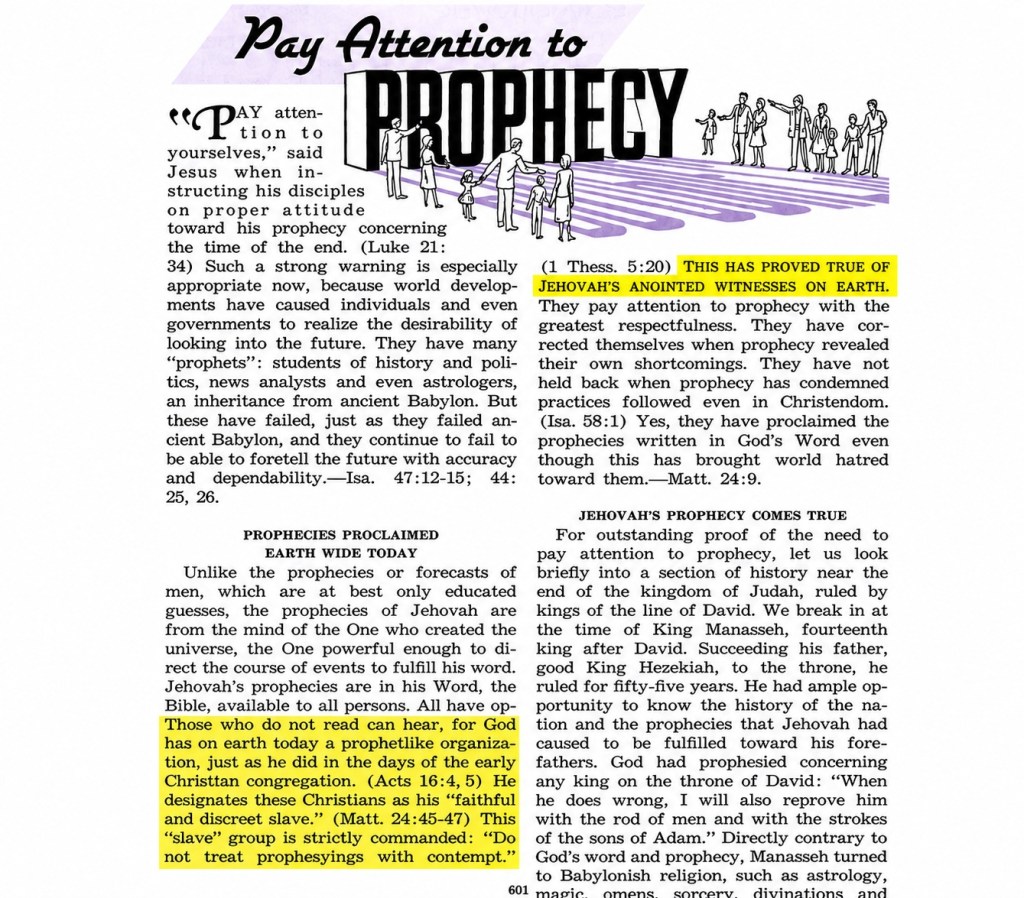
The Watchtower, October 1, 1964, 601.
“Those who do not read can hear, for God has on earth today a prophetlike organization, just as he did in the days of the early Christian congregation. (Acts 16:4,5) He designates these Christians as his “faithful and discreet slave”. (Matt. 24:45-47) This “slave” group is strictly commanded: “Do not treat prophesyings with contempt.” (1 Thes. 5:20) This has proved true of Jehovah’s anointed witnesses on earth.”
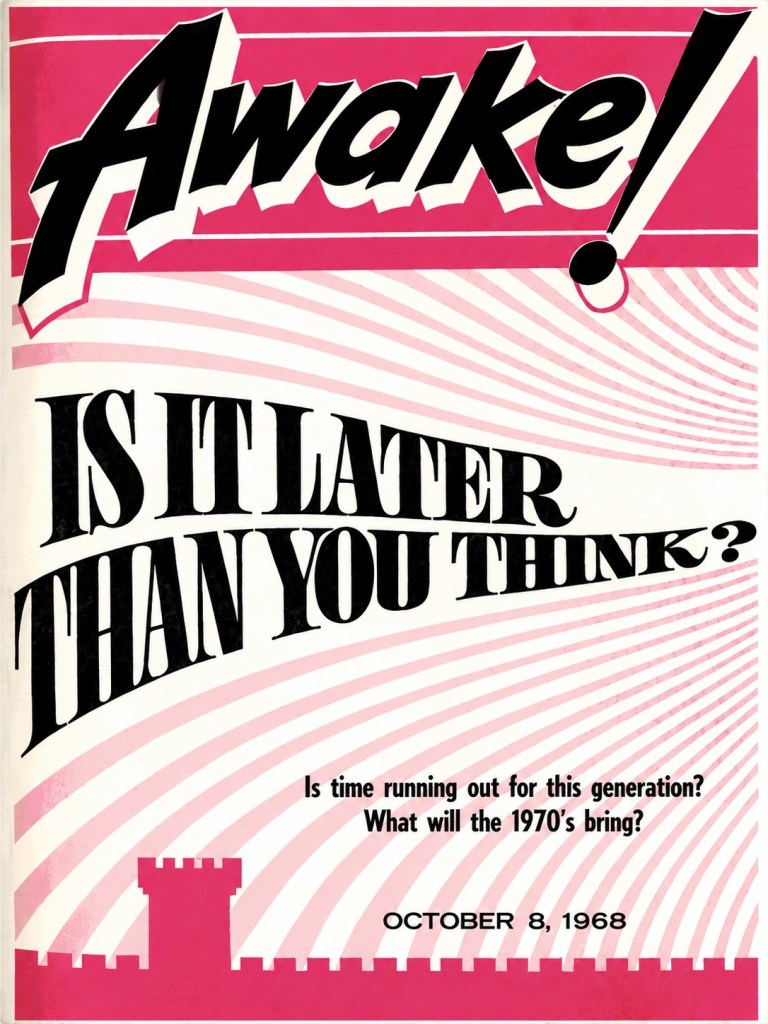
Awake! 1968, Oct. 8
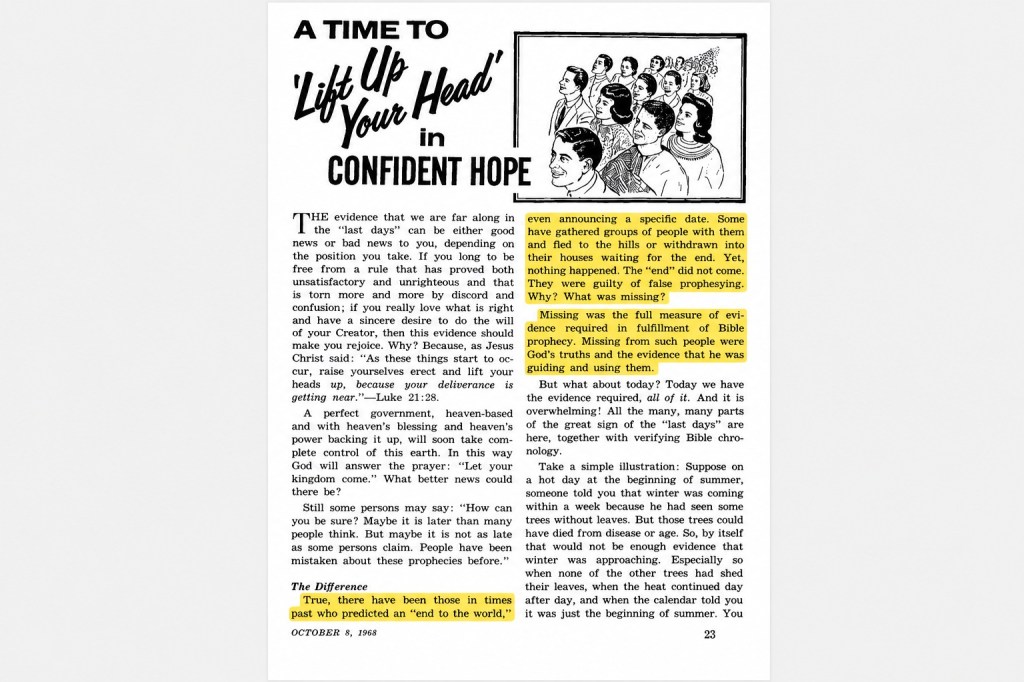
Awake! 1968, Oct., p. 23
“True, there have been those in times past who predicted an “end to the world,” even announcing a specific date. Yet nothing happened. The “end” did not come. They were guilty of false prophesying. Why? What was missing?”
“Missing was the full measure of evidence required in fulfillment of Bible prophecy. Missing from such people were God’s truths and the evidence that he was guiding and using them.”
The significance of this statement is hard to miss. Four years before the Watchtower’s famous 1972 article identifying Jehovah’s Witnesses as God’s prophet, Awake! clearly stated that anyone who predicts specific dates that fail to occur is guilty of false prophesying. It also claimed that a true prophet would possess God’s truth and evidence of divine guidance.
This raises an important question: Did the Watchtower’s own prophetic claims meet the standard it set for others?
In 1972, the Watchtower made one of its clearest claims to prophetic authority in an article entitled, “They Shall Know That a Prophet Was Among Them.“
My thinking at that time was, we’d show them! We’d show the world! We were God’s chosen people! We’d prove it, we would warn them about the impending Armageddon by going door-to-door. Then they would know! It would be another thirteen years before I’d realize just how wrong this was.
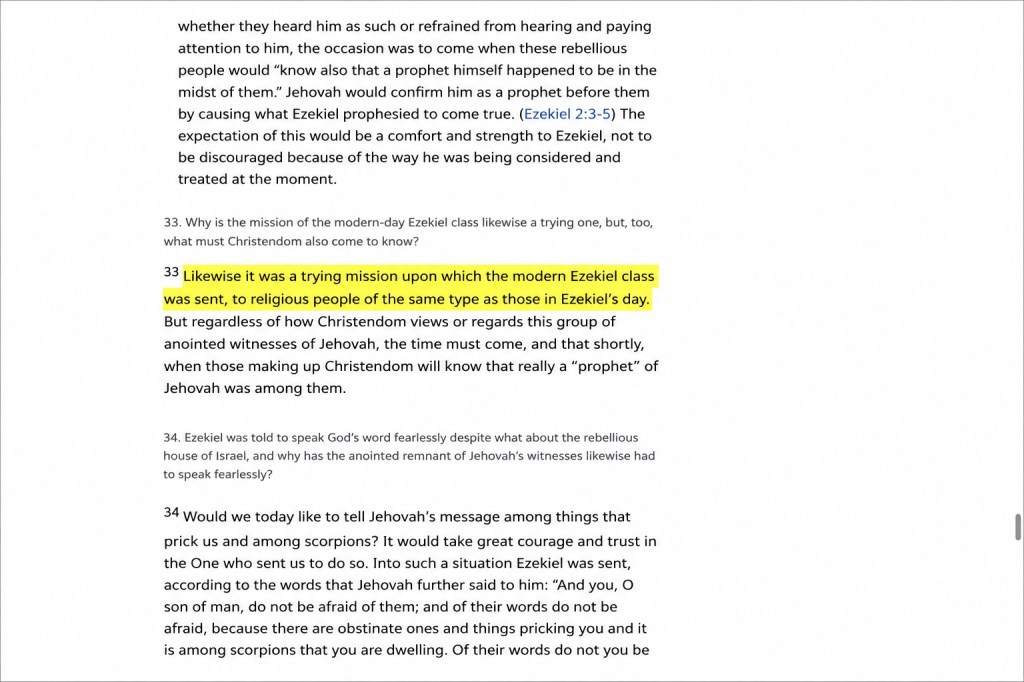
The Nations Shall Know That I Am Jehovah—How? (1971), p. 70, par. 33
“Likewise it was a trying mission upon which the modern Ezekiel class was sent, to religious people of the same type as those in Ezekiel’s day.”
“But regardless of how Christendom views or regards this group of anointed witnesses of Jehovah, the time must come, and that shortly, when those making up Christendom will know that really a ‘prophet’ of Jehovah was among them.“

The Watchtower, April 1, 1972, pp. 197–199
“So, does Jehovah have a prophet to help them, to warn them of dangers and to declare things to come?”
IDENTIFYING THE ‘PROPHET’
“These questions can be answered in the affirmative. Who is this prophet?
… This ‘prophet’ was not one man, but was a body of men and women. It was the small group of footstep followers of Jesus Christ, known at that time as International Bible Students. Today they are known as Jehovah’s Christian witnesses.
… Thus this group of anointed followers of Jesus Christ, doing a work in Christendom paralleling Ezekiel’s work among the Jews, were manifestly the modern-day Ezekiel, the ‘prophet’ commissioned by Jehovah to declare the good news of God’s Messianic Kingdom and to give warning to Christendom.”
This article leaves little room for interpretation. The Watchtower did not merely compare itself to biblical prophets or claim to preach a prophetic message. It explicitly identified Jehovah’s Witnesses as God’s modern-day “prophet” and described them as the modern-day Ezekiel commissioned by Jehovah to warn Christendom.
This 1972 article remains one of the clearest and most direct statements the organization ever made regarding its prophetic role.
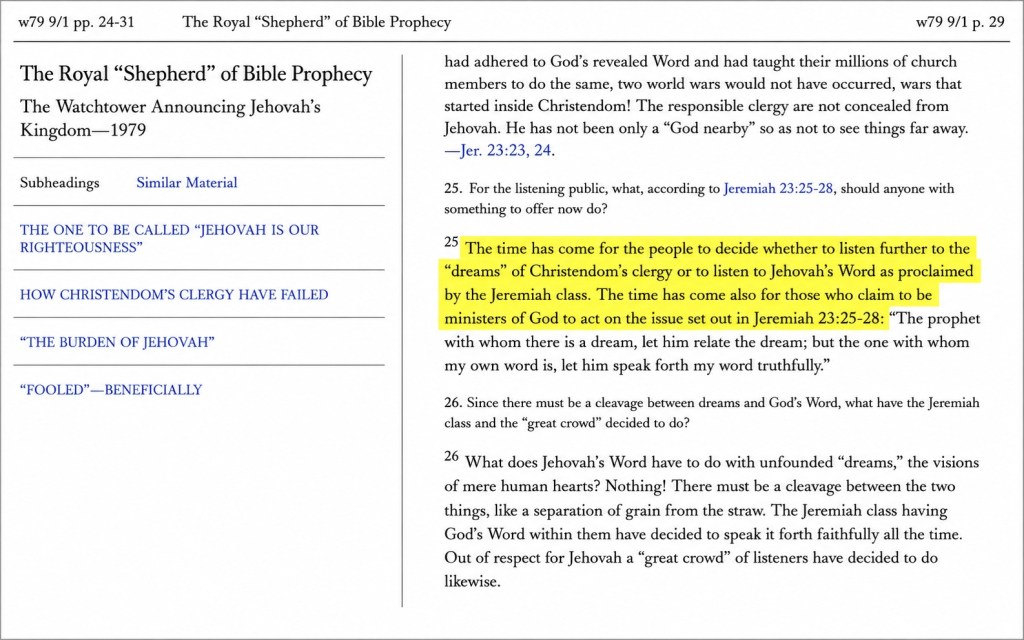
Watchtower 1979, 9/1, para. 25
By 1979, the terminology had changed, but the claim had not. The Watchtower continued to present the Jeremiah class as speaking Jehovah’s Word with divine authority.
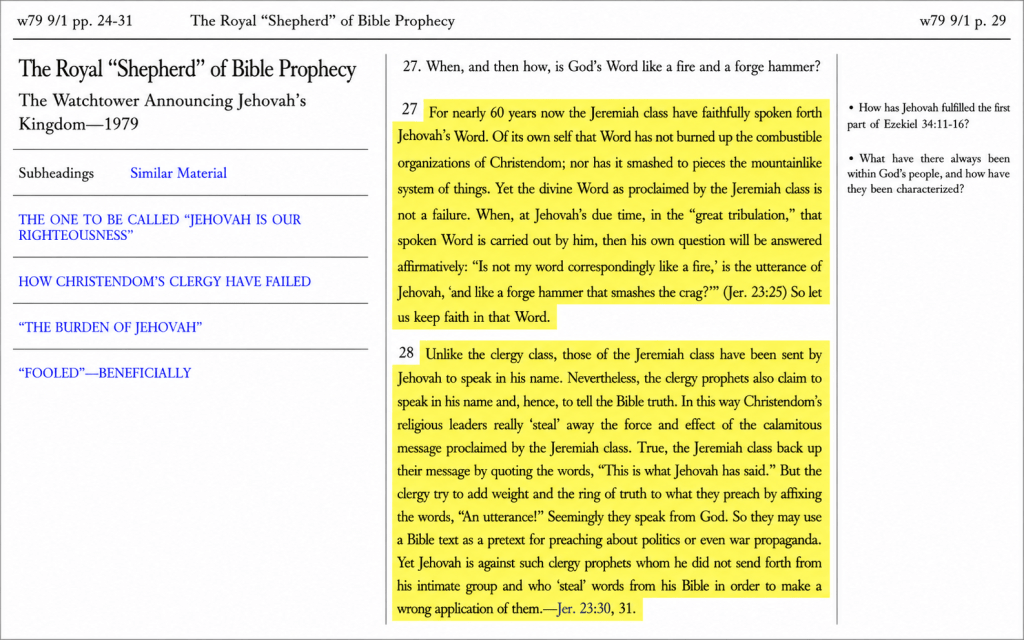
Watchtower 1979, 9/1, para. 27,28
The claim became even more explicit. The Jeremiah class was said to have “faithfully spoken forth Jehovah’s Word” for nearly sixty years and to have been sent by Jehovah to speak in His name.
One of the key statements is: “For nearly 60 years now, the Jeremiah class have faithfully spoken Jehovah’s word.”
That statement is important because it is not merely saying that Witnesses preach the Bible. It presents the “Jeremiah class” (the anointed Witnesses) as speaking Jehovah’s word in a prophetic role.
For a timeline, this is significant because the organization is presenting the “Jeremiah class” as speaking Jehovah’s word, not merely discussing Scripture.
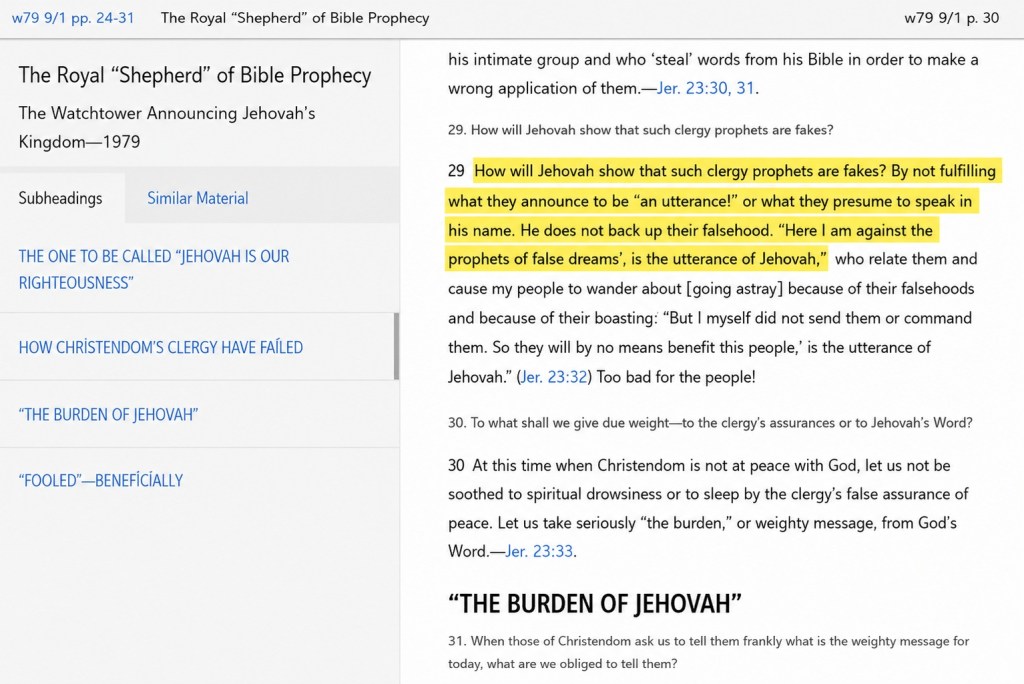
September 1, 1979 (Watchtower)
“How will Jehovah show that such clergy prophets are fakes? By not fulfilling what they announce to be “an utterance!” or what they presume to speak in his name. He does not back up their falsehood. “Here I am against the prophets of false dreams’, is the utterance of Jehovah.”

Watchtower 1991, 3/15 13-18 par. 3,4
“Similarly, God now has a single organizational instrument in his control. The Ezekiel class, the anointed remnant, is at the forefront of the work of giving a final witness, with “a great crowd” of “other sheep” rallying around in support. (Revelation 7:9,10; John 10:16)
As Ezekiel did not raise up or appoint himself as a prophet, so God’s visible organization did not create or appoint itself. It did not spring from human will or effort. The divine Chariot Rider caused this organization to come into existence. Empowered by God’s spirit and backed by holy angels, Jehovah’s people have experienced such dramatic expansion that the small one has become a mighty nation.” Isaiah 60:22.
Nearly twenty years after the 1972 prophet article, the Watchtower was still identifying the anointed remnant as the modern Ezekiel class and describing the organization as appointed by God rather than by men.

The Watchtower, March 15, 2011 “Keep Awake, as Jeremiah Did”, par. 5
Nearly forty years after the 1972 prophet article, the Watchtower was still identifying the anointed remnant as the modern Jeremiah class charged with warning mankind.
Current Teaching
The irony is difficult to miss.
1972: “We are the prophet.”
1979: We speak Jehovah’s Word.
1991: We are the Ezekiel class.
2011: We are the Jeremiah class.
Today: “Jehovah’s Witnesses do not claim to be inspired prophets.”
“On that day every prophet will be ashamed of his vision when he prophesies… He will say, ‘I am no prophet.'” (Zechariah 13:4-5)
Today, the Watchtower claims:
“Jehovah’s Witnesses do not claim to be inspired prophets.”
Yet the Watchtower once applied Zechariah 13:4-5 to false prophets who would eventually deny being prophets at all:
“Jehovah, the God of the true prophets, will put all false prophets to shame either by not fulfilling the false predictions of such self-assuming prophets, or by having His own prophecies fulfilled in a way opposite to that predicted by the false prophets. False prophets will try to hide their reason for feeling shame by denying who they really are. He will certainly say, ‘I am no prophet.'”
Paradise Restored to Mankind—By Theocracy! (1972), chap. 20, pp. 344-365, par. 22.
Ironically, the Watchtower applied this passage to false prophets who would eventually deny being prophets at all. Yet today the organization insists that it has never claimed to be an inspired prophet, despite decades of publications describing itself as a prophet, a prophetlike organization, the modern Ezekiel, and the Jeremiah class speaking Jehovah’s Word.
Today, the Watchtower claims, “Jehovah’s Witnesses do not claim to be inspired prophets.”

Paradise Restored to Mankind—By Theocracy! (1972) chap. 20 pp. 344-365, par. 22
“Jehovah, the God of the true prophets, will put all false prophets to shame either by not fulfilling the false predictions of such self-assuming prophets, or by having His own prophecies fulfilled in a way opposite to that predicted by the false prophets. False prophets will try to hide their reason for feeling shame by denying who they really are. He will certainly say, ‘I am no prophet.'”
Conclusion
One scripture rarely discussed in connection with the Watchtower’s prophetic claims is Deuteronomy 18:20-22. Yet it provides a straightforward test for anyone claiming to speak for God:
But a prophet who presumes to speak in my name anything I have not commanded, or a prophet who speaks in the name of other gods, is to be put to death.”
21 You may say to yourselves, “How can we know when a message has not been spoken by the Lord?” 22 If what a prophet proclaims in the name of the Lord does not take place or come true, that is a message the Lord has not spoken. That prophet has spoken presumptuously, so do not be alarmed. Deut. 18:20-22
Like many Jehovah’s Witnesses, I never questioned the Watchtower’s claims. They were simply accepted as fact. Years later, when I began investigating where these teachings came from, I was surprised by what I found.
Gradually, the Watchtower taught us to place our trust in the organization. Its history was introduced a little at a time, carefully edited, and presented from the organization’s perspective. In those days there was no internet, and verifying claims was far more difficult, especially in a small town like the one where I lived. Some of the claims seemed plausible. Others seemed outrageous. But when you are young, impressionable, and surrounded by people who appear to know the Bible better than you do, it is easy to accept what you are told.
Helping a Jehovah’s Witness critically examine Watchtower claims can be challenging because years of organizational teaching often discourage questioning those claims. For that reason, I usually focus on clear, black-and-white evidence—a straightforward Scripture or a Watchtower quotation that is difficult to explain away.
One of those claims is the Watchtower’s repeated assertion over many decades that it served as God’s prophet, spokesman, watchman, Jeremiah class, Ezekiel class, faithful slave, and channel of communication. The terminology changed, but the claim remained the same: God was using this organization to speak His message to mankind.
Today, the Watchtower says that Jehovah’s Witnesses do not claim to be inspired prophets. Yet the historical record shows decades of publications describing the organization in prophetic terms and claiming divine authority for its warnings, teachings, and predictions.
Each Jehovah’s Witness is unique. Different evidence reaches different people. For some, it may be the failed prophetic dates. For others, it may be the organization’s changing teachings, its claim to be God’s sole channel, its association with the United Nations, or its handling of child sexual abuse cases. We never know which piece of evidence may cause someone to stop and reconsider.
So gather the facts. Learn the history. Pray for opportunities. And when those opportunities come, ask thoughtful questions that encourage people to examine the evidence for themselves.
The next time you speak with a Jehovah’s Witness, consider asking:
“If this teaching came from Jehovah, why did it change so many times?”
“Did God get it wrong the first time, or were these simply the interpretations of men?”
“Can new light correct old light, or does that mean the old light wasn’t actually light from Jehovah in the first place?“

