What Is a Cult?
When most people hear the word cult, they picture a group of fanatics living on a remote compound somewhere, waiting for aliens to arrive or stockpiling weapons for the end of the world.
The reality is usually far less obvious.
Most cults don’t look like cults.
They have normal-looking people, normal jobs, normal families, and normal lives. Cult members shop at the same stores, live in the same neighborhoods, and work alongside everyone else. Many cult members are intelligent, sincere, and genuinely believe they are part of something good.
What separates a cult from a religion, political movement, business, or social organization is not what it claims to believe. It is the amount of control it exercises over its members.
A healthy organization allows people to ask questions, disagree with leadership, conduct independent research, and leave without fear of punishment.
A cult does the opposite.
Cults demand conformity. They discourage critical thinking. They control information. They pressure members to put the group above family, friends, and sometimes even their own conscience. Most importantly, they make leaving extremely costly.
The more difficult it is to question the organization and the more severe the consequences for leaving, the closer you are to cult territory.
Many people imagine cult members must be gullible or unintelligent. The truth is that almost anyone can be recruited under the right circumstances. Cults do not succeed because their members are stupid. They succeed because they understand human psychology.
That is why recognizing the warning signs is so important.
Who Do Jehovah’s Witnesses Target?
Jehovah’s Witnesses are taught, indirectly, to look for people who are vulnerable and more likely to accept their message. During my years in the organization, it became clear that some people were viewed as more promising prospects than others.
Young and inexperienced people are often seen as easier to recruit because they may lack the life experience, discernment, or critical thinking skills needed to recognize manipulation and high-control tactics. Other common targets include the elderly, the lonely, those with intellectual disabilities, and especially people who have recently experienced a major loss such as a death, divorce, illness, or financial crisis.
Why? Because people in pain are searching for answers. They are often emotionally vulnerable and looking for hope, community, and certainty. Cults thrive on offering simple answers to complex problems.
At the same time, Witnesses tend to avoid people who know their Bible well, are familiar with the organization’s history, or ask difficult questions that challenge official teachings. The goal is not an open exchange of ideas. The goal is conversion.
Jehovah’s Witnesses are trained in recruitment techniques, although these are presented as ways to “help people.” I remember hearing instructions such as:
- “If there are toys in the yard, focus on the benefits God’s Kingdom will bring to children.”
- “If there is a mezuzah on the doorframe, you’ll know they are Jewish, so use the Old Testament.”
- “Always find something to compliment the householder on. Their garden. Their home. Their pets. Find common ground.”
On the surface, these may sound harmless. In reality, they are techniques designed to build rapport, lower defenses, and open the door to further indoctrination.
Former Witnesses understand that the initial conversation is rarely the real objective. The objective is to start a Bible study, establish trust, and gradually introduce the organization’s teachings and authority structure.
How Cult Recruitment and Indoctrination Work
No one who is in a cult knows they are in a cult.
People do not knowingly join harmful groups. They join what appears to be a religion, a political movement, a worthy cause, a self-help program, or even a business opportunity. Cults are not always religious, and they are not always political. There are business cults, self-help cults, multi-level marketing cults, and countless other variations. The common denominator is not the subject matter—it is the control.
The recruitment process is deceptive by design. In most cases, the people recruiting you don’t realize they are in a cult themselves. They genuinely believe what they are preaching, selling, or trying to convince you of. That is what makes them so convincing. They are not usually lying to you. They are repeating what they have been taught to believe.
The indoctrination process is rarely sudden. It is usually slow, methodical, and carefully paced. Critical thinking is not destroyed overnight. Independence is not taken away in a single step. Instead, it is chipped away little by little until the changes begin to feel normal.
Most cults have their own language and terminology. The recruiter gradually introduces these words and phrases until they become familiar. Before long, you find yourself speaking the language of the group without even realizing it. They may bring different members with them when they visit so that you become comfortable with a wider circle of people. They want you to feel accepted, welcomed, and understood.
Eventually, they become your new best friends.
New recruits are often showered with attention, affection, praise, and encouragement. This is commonly known as “love-bombing.” It feels wonderful at first. Who doesn’t want to feel loved, appreciated, and important? What many people don’t realize is that this love often comes with strings attached. The affection is abundant while you are moving toward the group. It can disappear the moment you begin questioning it.
Cult members usually don’t realize they are being coerced or controlled because the process happens slowly over time. Every restriction is presented as reasonable. Every new rule is packaged as helpful advice.
“Don’t watch that television show because it promotes immorality.”
“Be careful about the music you listen to.”
“Check the lyrics. They may not be pleasing to God.”
At first, these suggestions may sound harmless. They may even sound wise. But the goal is not simply to help you make better decisions. The goal is to train you to adopt the group’s standards as your own.
Before you know it, you’ve stopped watching certain shows, stopped listening to certain music, stopped reading certain books, and stopped associating with certain people. The changes happen so gradually that you barely notice them.
The key difference is this: in a healthy environment, people are free to make these decisions for themselves. In a cult, the decisions have effectively been made for you.
If you wear something that is considered inappropriate, you may be counseled by leaders or corrected by older members. Since nobody enjoys being criticized or getting into trouble, you quickly learn how to avoid negative attention. You adjust your behavior. You censor your thoughts. You become careful.
Very careful.
Before long, you’re walking on eggshells. You watch what you say, what you wear, what you read, what you watch, and even what you think. You hesitate to mention the latest movie you enjoyed or the novel you just finished because you already know someone is going to lecture you about it.
Welcome to life in a cult.
You may wonder how people get lured into a cult in the first place.
In the case of Jehovah’s Witnesses, the process often begins with a promise. Years ago, that usually happened at your front door. Today, it may happen through a co-worker, a neighbor, a family member, or even online.
First comes the bait.
The hook.
For Jehovah’s Witnesses, that hook is often the promise of a paradise earth. A world without sickness, suffering, aging, or death. A place where you can live forever with your loved ones.
It is a powerful message because it appeals to some of the deepest desires people have.
The problem is that Jehovah’s Witnesses have been teaching that this paradise is just around the corner for well over a century. Since the late 1800s, generations of Witnesses have believed they would see the end of the present system and the arrival of paradise in their lifetime.
Every one of those generations grew old.
Every one of those generations died.
And paradise never came.
Yet the promise remains the same, offered to a new generation of recruits who are told that the end is now closer than ever.
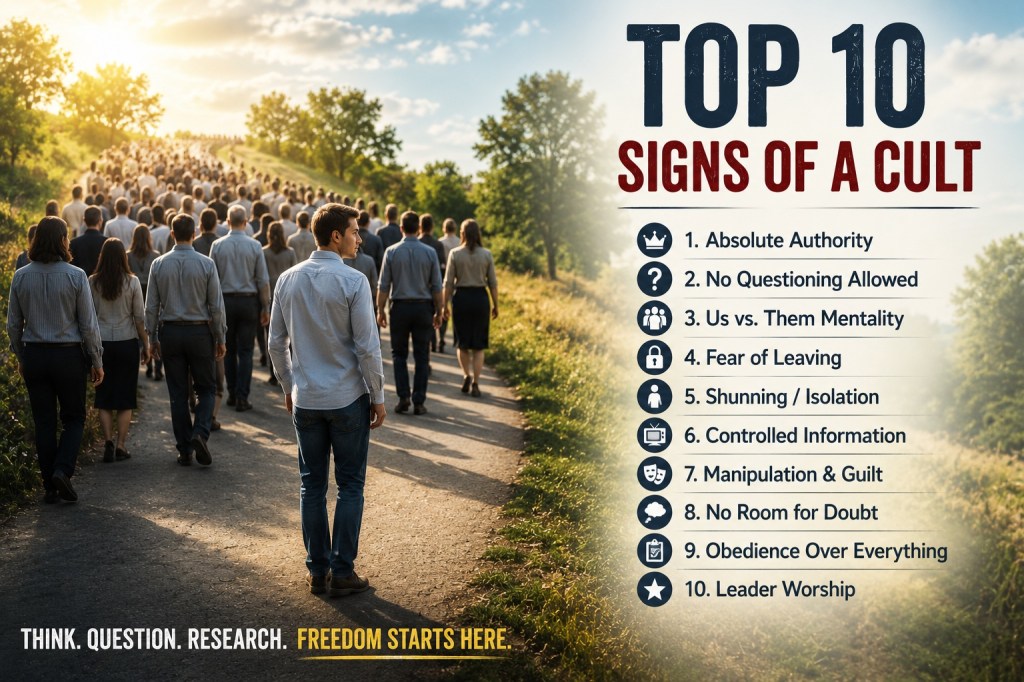
Top Ten Warning Signs of a Cult
People often ask how to identify a cult. While every group is different, experts who study cults and high-control organizations have identified a number of common warning signs. Jehovah’s Witnesses display many, if not all, of these characteristics.
- Authoritarian Leadership – Members are not free to openly question leadership, doctrine, or policy. Disagreement comes with consequences.
- Leaders Are Not Accountable – Failed predictions, harmful policies, and damaging decisions are rarely acknowledged. Leaders do not answer to the membership.
- An “Us Versus Them” Mentality – Members are taught that the outside world is dangerous, corrupt, and under Satan’s control. Criticism is viewed as persecution.
- Isolation From Former Members – Current members are forbidden from maintaining normal relationships with former members, especially those who speak critically about the organization.
- Mishandling of Abuse Cases – The organization’s handling of child sexual abuse allegations has been the subject of worldwide controversy, lawsuits, and investigations. The infamous “two-witness rule” has been heavily criticized by victims and advocates.
- Punishment for Leaving – Once baptized, there is no simple way out. Leaving often means losing your family, friends, and entire support network through shunning.
- Exclusive Access to Truth – Members are taught that the organization alone possesses God’s truth and that obedience to leadership is necessary for salvation.
- Salvation Is Tied to Performance – Members are expected to spend significant time recruiting others, attending meetings, studying publications, and supporting organizational activities.
- Loyalty to the Organization – Members are repeatedly reminded that loyalty to the organization must come before personal opinions, family relationships, or independent thinking.
- Information Control – Members are discouraged from reading, watching, or listening to anything critical of the organization. Former members are often labeled as dangerous or spiritually diseased.
As a former Jehovah’s Witness, I experienced many of these things firsthand. When I eventually left, I was shunned by people I had known for years. Like many former members, I struggled with the devastating emotional consequences of losing an entire community overnight.
That is why I believe people should understand what they are getting into before opening the door, accepting a Bible study, or becoming involved with the organization. Recruitment is easy. Leaving can cost you everything.


So well written! Thank you for sharing this.
LikeLiked by 1 person
Thanks so much! I appreciate that and it means a lot coming from you!
LikeLiked by 1 person
Very well written and you touched on all of the main points in a easy descriptive way. I will send this to my older sister as I am not giving up on her.
LikeLiked by 1 person